What’s the Worst Kind of Debt?

DEBT inscription bright green lettersWhat is the worst kind of debt to carry? Is it student loan debt, credit cards, a mortgage — or something else? Even the experts don’t always agree on which debt is “good debt” and which is “bad,” so imagine how confusing it can be to consumers who are dealing with debt!

Student Loan Debt

Why student loan debt is the worst: The loans are often given to young people with no credit experience and no clue how they will pay them back. Balances are often high, and the jobs borrowers counted on to make payments may be non-existent or take a really long time to acquire. Finally, unlike every other type of consumer debt, it is very difficult to discharge balances in bankruptcy.

And why it may not be: College graduates, on average, still earn significantly more over their lifetime than those without a college degree. In that sense, student loan debt can be considered an investment that pays off in future earning power. In addition, students may be able to defer payments on their student loans during times of economic hardship (usually at a cost), which makes them more flexible than other types of loans. In addition, borrowers may be eligible for reduced payments and loan forgiveness under the Income-Based Repayment Program or other loan forgiveness programs.

How does student debt affect credit scores? Large balances typically don’t hurt credit scores as long as the payments are made on time.

Credit Card Debt

Why credit card debt is the worst: With interest rates hovering around 15 percent on average — and more than 20 percent for some borrowers — credit card debt is often the most expensive kind of debt consumers carry. And with the low minimum monthly payments that issuers offer, cardholders can find themselves in debt for decades if they aren’t careful.

And why it may not be: While making minimum payments on credit cards is not a great idea over the long run, having that option can come in handy in a financial pinch. It can give cardholders time to get back on their feet without ruining their credit.

As far as credit scores are concerned, as long as cardholders keep balances low (usually below 10 to 20 percent of their available credit), and make minimum payments on time, credit card debt should not hurt credit scores.

Mortgage Debt

Why mortgage debt is the worst: If you wonder how bad mortgage debt can be, just ask the owners of some $8.8 million homes that CoreLogic said had negative or near-negative equity as of the second quarter of 2013. That means those owners owe close to, or more than, what the property is worth. That also means they can’t sell those houses without shelling out money to pay off their mortgage or doing a short sale that damages their credit scores. Even for those who aren’t under water, rising taxes and/or insurance premiums, the cost of maintenance and loans that typically take 30 years to pay off can make one’s home feel like a financial prison at times.

And why it may not be: Over time, homeownership remains one of the key ways average Americans build wealth. If you are able to keep up with your home loan payments, eventually the home will be paid off and provide inexpensive housing or rental income. Equity that has built up can be accessed through a reverse mortgage or by selling the house, or it can be passed along to heirs — sometimes tax-free.

When it comes to credit scores, this type of loan will generally help, as long as payments are made on time. Even large mortgages shouldn’t depress credit scores, unless there are multiple mortgages with balances. That’s usually a problem that affects real estate investors however, not homeowners with one or two homes.

Tax Debt

Why tax debt is the worst: If you owe the Internal Revenue Service or your state taxing authority for taxes you can’t pay, you can suffer a variety of painful consequences. If a tax lien is filed, your credit scores will likely plummet. In addition, these government agencies usually have strong collection powers, including the ability to seize money in bank accounts or other property, or to intercept future tax refunds.

And why it may not be: The IRS offers repayment options that may allow a tax debt to be paid off over time at a fairly low rate. (Similar programs are available for state tax debt in many states). And unlike applying for a loan, you don’t have to have good credit to get approved for an installment agreement.

The good news when it comes to credit scores is that tax debt itself isn’t reported to credit reporting agencies; a tax lien is the only way that it may show up. By entering into an installment agreement, you may be able to get a tax lien removed from your credit reports, even before you’ve paid off what you owe.

Auto Loan Debt

Why auto debt is the worst: The average auto loan now lasts five and a half years, and some 12 percent last six to seven years, according to Edmunds.com. That means payments will last long after that new car smell has worn off and well into the years when maintenance and repair costs start creeping up. Even more troubling, these borrowers may be stuck if they need to sell their vehicles since they may be “upside down,” owing more than what they can sell their car or truck for.

And why it may not be: Many consumers budget for a car payment, and as long as they aren’t hit with unexpected expenses, they are able to make this payment a priority. In addition, borrowers may be able to refinance their auto loans and lower their monthly payments. Plus, cars often get people to work, where they can earn the money they need to pay off debt.

Vehicle loans that are paid on time can help credit scores, and are rarely a problem unless someone has several car loans outstanding at once or misses a payment.

The Worst Kind Of Debt

When it comes down to it, the worst type of debt is … (drumroll please), the one you can’t pay back on time. If that happens, your credit scores will suffer, your balances may grow larger due to fees and interest, and you may find yourself borrowing even more as you try to keep up with your payments.

Article Source: http://www.huffingtonpost.com/creditcom/whats-the-worst-kind-of-d_b_4220046.html 
52 Week Savings Challenge

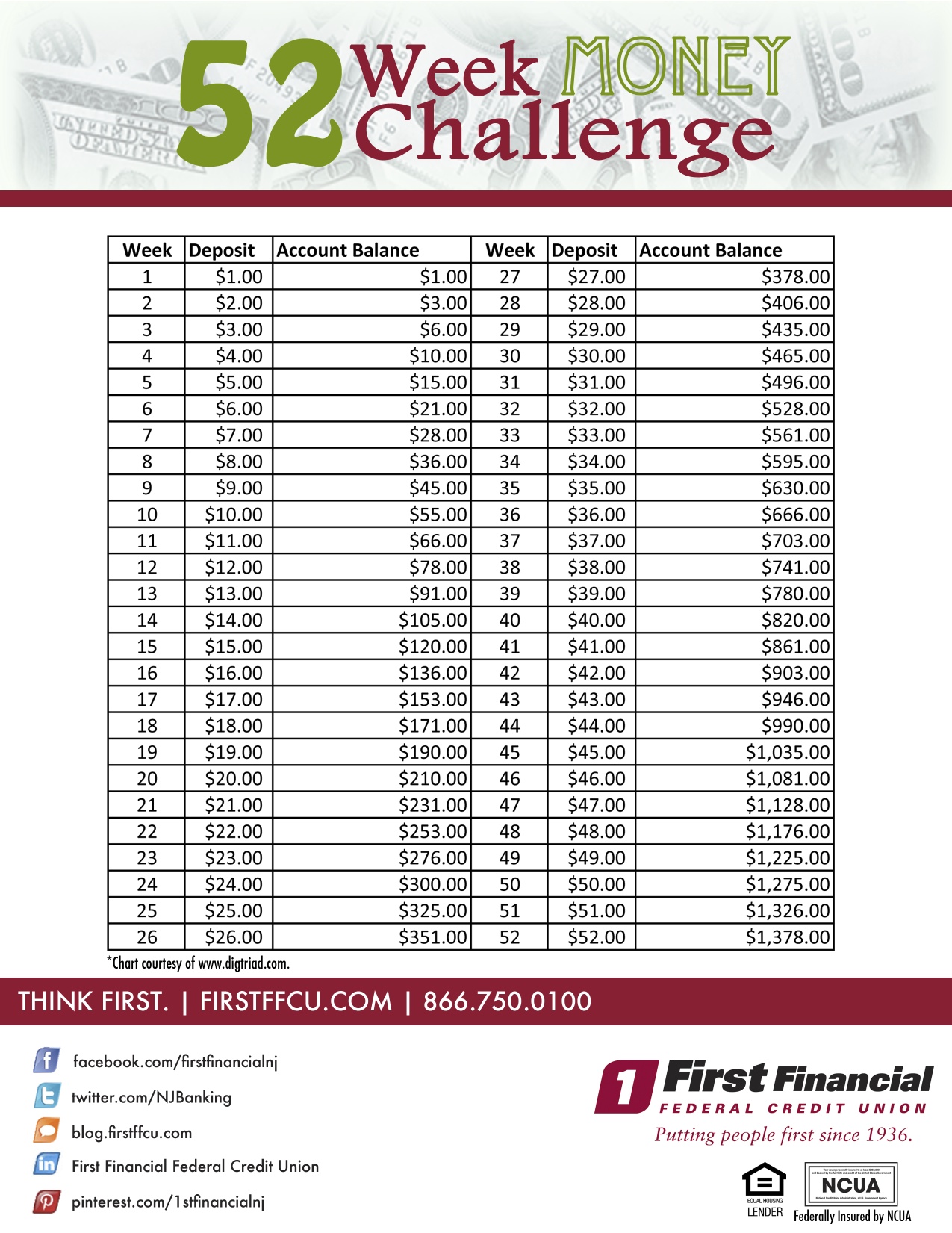
Start your new year off the right way – by saving money.  Take the 52 week money challenge below, and you’re guaranteed to save almost $1,400 by the start of the new year. Ready, set, go!

52WeekMoneyChallenge JPEG

9 Ways to Simplify Your Finances Now

simpify financesIf managing personal financial affairs were easy, we probably wouldn’t graduate nearly 70,000 accountants each year. Budgets, credit cards, insurance, retirement savings and more—it’s a lot to track, and things are getting more complex all the time.

A lot of people are losing the battle. One in three adults who say their finances have taken a turn for the worse also say their finances have grown more complex, according to a survey from Aite Group. Likewise, 43% of those who say their finances have improved also say their finances have grown less complex.

Simple is good. It’s understandable. It’s manageable. It doesn’t eat up a lot of time. It breeds confidence and makes tough decisions easier. “The financial frenzy people experience comes from being disconnected from their personal income,” says Melody Juge, managing director at Life Income Management.

Some things can’t be made simple. Income tax filing comes to mind, at least for some people. So do retirement account distributions. You can’t know how long you’ll live. But other things don’t have to be so difficult. Maybe you can get control of your money with a few simple tricks. Here are nine ways most Americans can simplify their personal finances:

  • Get down to one mutual fund. You’ll get great asset allocation and solid diversification within asset groups with just one target-date mutual fund. These are the fastest growing corner of the retirement savings world precisely because they are so simple. Choose a target-date fund for the year you turn 65 or 70, put all your retirement savings in it and go about the rest of your life knowing you have professional management and an asset allocation that will become more conservative as you age. Of course, there are drawbacks and you’ll have to look out for expenses when you choose. But investing for the long haul has never been simpler.

Questions about retirement savings or investments?  If you would like to set up a no-cost consultation with the Investment & Retirement Center located at First Financial Federal Credit Union to discuss your brokerage, investments, and/or savings goals, contact us at 732.312.1500 or stop in to see us!*

  • Keep two credit cards. You will save a bundle in annual fees and rid yourself of umpteen bills and solicitations. Use one card for monthly spending and the other only when you must carry a balance. Keep cards with the lowest interest rates or annual fees, or those that offer useful rewards.
  • Pay bills online. Most financial institutions offer an online bill pay service for no charge. Stamps, envelopes and physical checks are an obsolete expense. You’ll save time too. But best of all, your bank or credit union will automatically keep track of what you spend and where you spend it for easy review, which makes budgeting a lot simpler.
  • Choose one financial institution. You can probably get everything you need in one place. Stick with one. You’ll not only get better service, but cut down on monthly statements and get a better picture of your overall finances.
  • Automate everything. Arrange for direct deposit of your paycheck to eliminate constant car trips to your financial institution. Arrange for regular payroll or bank account debits to your retirement account — and for automatic increases in the amount as you get pay raises — to keep savings on track. Arrange automatic monthly payments via your online bill pay system to creditors to cover the minimum due and avoid late fees.
  • Get overdraft protection. Link your checking account to your savings account to avoid the cost and hassle of overdrawing your account.
  • Create an emergency fund. The goal is to set aside six months of living expenses to guard against unexpected expenses that derail your plans. But don’t let what may seem a large sum deter you. Start with $500, which is enough to cover the cost of most minor household emergencies. Add $100 a month until you reach your goal.
  • Pay yourself first. You should be saving at least 10% of what you make every month. Write that check first and budget to live off of what’s left.
  • Get organized through new technologies. Account aggregation through your financial institution or a service like Mint.com will allow you to view all your accounts in one place, says Linda Sherry, national priorities director at Consumer Action. She also recommends using a password manager like 1password or Dashlane to simplify your online transactions from any device, and setting up a folder in email for increasingly common online account statements.

*Securities and advisory services are offered through LPL Financial (LPL), a registered investment advisor and broker/dealer (member FINRA/SIPC). Insurance products are offered through LPL or its licensed affiliates. First Financial Federal Credit Union (FFFCU) and First Financial Investment & Retirement Center are not registered as a broker/dealer or investment advisor. Registered representatives of LPL offer products and services using First Financial Investment & Retirement Center, and may also be employees of FFFCU. These products and services are being offered through LPL or its affiliates, which are separate entities from and not affiliates of FFFCU or First Financial Investment & Retirement Center.

Securities and insurance offered through LPL or its affiliates are:

Article Source: http://business.time.com/2013/09/20/9-ways-to-simplify-your-finances-now/

Budget Tips for Planning for Life’s Unexpected Curve Balls

couple-worry-moneyLife doesn’t always go as planned, and many of life’s major events, like getting married, having a baby and buying a home can crowd your savings capability and even throw you into a financial tailspin.

When it comes to making ends meet, retirement is often left out of the savings equation. Eighty-four percent of people say saving for retirement has been undercut by a life event, according to this year’s HSBC Future of Retirement survey of more than 15,000 people. But people react differently when in crunch mode, the survey says, and in some cases, extreme measures are required to cover budget needs. Three tactics improve cash flow in a financial crunch: increase income, decrease expenses or a combination of both.

Time to Downsize?

In reality, you have more control on your spending side, particularly with flexible expenses like travel, entertainment, gifts and food. But if your financial woes seem irreversible, you may have to take a hammer to large expenses like housing.

In fact, 21% of women surveyed say they would downsize, compared to only 14% of men. And 31% of men say they would dip into their retirement savings to cover unexpected expenses.

Though experts concede downsizing may be extremely emotional, it’s more preferable than taking a chunk out of retirement savings. Actually, 29% of respondents say the financial strain of home ownership puts a real crimp in retirement savings.

If you have any questions about the home buying process, feel free to ask us! We know it can be an intimidating process at times, and we’re here for you. To learn more about a 10, 15, 20, or 30 year First Financial Mortgage – click here.*

Rethink Your Lifestyle.

Today’s lifestyle norms may have something to do with one-dimensional thinking. Items once seen as luxuries are now seen as necessities, says Ravi Dhar, director of the Yale Center for Customer Insights.

Plus, what people do with their money has more to do with psychological and emotional issues than it does with crunching the numbers, claims Marcee Yager, a retired certified financial planner. “It’s never just about the money.”

Because non-financial issues often dictate financial decisions and create a domino effect, consumers need to look at both quantitative (intellectual) and qualitative (emotional) issues when making life choices, says Yager. “Without shared thinking, people’s heads start spinning.”

The idea that emotional understanding must be factored into financial decisions has gained very little traction, claims Yager. “Big investment banks don’t tend to make things soft and fuzzy.”

Dhar even questions the effectiveness of some system resources like the many online investment tools available to consumers. Calculators project four, six, or eight million dollar targets for a retirement 30 years into the future. He says the timeframe seems intangible and the goals unattainable.

For consumers looking to navigate their way out or steer clear of the financial weeds, experts offer the following:

Take small steps to wealth. The only way to build up reserves is to do it gradually. Budget a realistic portion of your paycheck to start an emergency fund or return to the basics. “The best thing people raising families can do is go back to the old traditional practice of putting money in an envelope or a cookie jar,” adds Yager.

Be flexible. Think about what’s possible to mitigate a tight financial situation. Baby boomers tend to be fearful of change, particularly of moving to unknown places, says Yager. In fact, new locales both in and outside of U.S. borders can create wonderful opportunities that improve your quality of life.

Keep a minimum three-month reserve for savings. Learn to cut corners, live on less and shop in cheaper places.

Write it down. Take a financial fitness quiz then put your pencil to paper. You need to see the numbers then monitor your day-to-day situation.

First Financial also hosts free credit management and debt reduction seminars throughout the year, so be sure to check our online event calendar or you can subscribe to receive upcoming seminar alerts on your mobile phone by signing up here.**

Turn to professionals. Reviewing your savings situation and retirement potential with a professional financial advisor can help to ensure that all your future requirements are identified.

If you would like to set up a no-cost consultation with the Investment & Retirement Center located at First Financial Federal Credit Union to discuss your brokerage, investments, and/or savings goals, contact us at 732.312.1500 or stop in to see us!***

Click here to view the article source, from FoxBusiness.com.

*A First Financial membership is required to obtain a mortgage and is open to anyone who lives, works, worships, or attends school in Monmouth or Ocean Counties. A First Financial Mortgage is subject to credit approval. See Credit Union for details. *

*Note: You must check the Text Message Signup box when registering in order to receive text messages. Standard text messaging and data rates may apply. If you do not receive an automated confirmation message after enrolling, please text “Yes” to (201) 808-1038

***Securities and advisory services are offered through LPL Financial (LPL), a registered investment advisor and broker/dealer (member FINRA/SIPC). Insurance products are offered through LPL or its licensed affiliates. First Financial Federal Credit Union (FFFCU) and First Financial Investment & Retirement Center are not registered as a broker/dealer or investment advisor. Registered representatives of LPL offer products and services using First Financial Investment & Retirement Center, and may also be employees of FFFCU. These products and services are being offered through LPL or its affiliates, which are separate entities from and not affiliates of FFFCU or First Financial Investment & Retirement Center.

Securities and insurance offered through LPL or its affiliates are:


4 Tips to Help 20-Somethings Manage Their Debt

Debt can be a heavy burden on anyone, no matter what their age, but increasingly, young adults are starting out deeper in the hole. A recent report from credit-score provider FICO shows that student loan debt has climbed dramatically for those ages 18 to 29, with average debt rising by almost $5,000 over the course of five years.

The good news, though, is that young adults are taking steps to get their overall debt under control, reducing their balances on credit cards and their debt levels for mortgages, auto loans, and other types of debt. With 16% of 18 to 29-year-olds having no credit cards, young adults are getting the message that managing debt early on is essential to overall financial health.

With the goal of managing debt levels firmly in mind, let’s take a look at four things you should do to manage your debt prudently and successfully.

1. Get a Handle On What You Owe.

In managing debt, the first challenge is figuring out all of what you owe. By pulling a free copy of your credit report you’ll get a list of loans and credit card accounts that major credit bureaus think you have outstanding, along with contact information to track down any unexpected creditors that might appear on the list.

Once you know what you owe, you also have to know the terms of each loan. By making a list of amounts due, monthly or minimum payment obligations, rates, and other fees, you can prioritize your debt and get the most onerous loans paid down first. Usually, that’ll involve getting your credit card debt zeroed out, along with any high rate debt like private student loans before turning to lower rate debt like mortgages and government subsidized student loans. With your list in hand, you’ll know where to concentrate any extra cash that you can put toward paying down debt ahead of schedule.

2. Look for Ways to Establish a Strong Credit History.

Having too much debt is always a mistake, but going too far in the other direction can also hurt you financially. If you don’t use debt at all, then you run the risk of never building up a credit history, and that can make it much more difficult for you to get loans when you finally do want to borrow money. The better course is to use credit sparingly and wisely, perhaps with a credit card that you pay off every month and use only often enough to establish a payment record and solid credit score.

First Financial hosts free budgeting, credit management, and debt reduction seminars throughout the year, so be sure to check our online event calendar or subscribe to receive upcoming seminar alerts on your mobile phone by signing up here.*

3. Build Up Some Emergency Savings.

Diverting money away from paying down long term loans in order to create a rainy day emergency fund might sound counterintuitive in trying to manage your overall debt. But especially if your outstanding debt is of the relatively good variety — such as a low rate mortgage or government subsidized student loan debt — having an emergency fund is very useful in avoiding the need to put a surprise expense on a credit card. Once you have your credit cards paid down, keeping them paid off every month is the best way to handle debt, and an emergency fund will make it a lot easier to handle even substantial unanticipated costs without backsliding on your progress on the credit card front.

4. Get On a Budget.

Regardless of whether you have debt or how much you have, establishing a smart budget is the best way to keep your finances under control. By balancing your income against your expenses, you’ll know whether you have the flexibility to handle changes in spending patterns or whether you need to keep a firm grip on your spending. Moreover, budgeting will often reveal wasteful spending that will show you the best places to cut back on expenses, freeing up more money to put toward paying down debt and minimizing interest charges along the way.

Click here to view the article source, from The Daily Finance.

Note: You must check the Text Message Signup box when registering in order to receive text messages. Standard text messaging and data rates may apply. If you do not receive an automated confirmation message after enrolling, please text “Yes” to (201) 808-1038