9 Signs You’re Spending More Money Than You Have to and How to Fix It

Expenses. Yellow Card File on Background of White PC Keyboard. Archive Concept. Closeup View. Blurred Illustration. 3D Rendering.

Sometimes it’s tough to find a healthy balance when it comes to your finances. While it’s nice to treat yourself every so often, doing it on the regular can be one of the signs that you may be spending too much money. Even though money is a taboo topic and can be a sensitive issue, it’s important to be honest with yourself. While it would be great to make millions of dollars and spend it frivolously all over town, you also need to keep your financial future in mind.

According to the financial app Mint, you might want to be more careful with your money if you’re not paying your bills on time, you’re paying for your necessities with credit cards, or you’re struggling to meet minimum payments. If you find yourself dealing with these things on the regular, it might be a good idea to create a budget and start using cash so you can keep an eye on your finances and spend less money. Feeling stressed about money is something that no one should have to deal with on a daily basis – that’s why it’s important to be honest with yourself and be aware of the signs that you’re spending too much.

Need some help in that department? Here are nine signs you may be spending more money than you need to.

1. You Carry A Large Balance On Your Credit Card

Having more than 30% of your credit card limit on your credit card is considered to be a big no-no. If you find that your credit card limit is higher than your savings account, you might want to switch things up. Some credit cards do have tools where you can track your expenses online. You can also use money apps such as Mint to figure out exactly where everything is going.

First Financial’s Visa® Platinum Cash Plus Credit Card comes fully loaded with  a lower APR, no annual fee, a 10-day grace period+, uChoose Rewards redeemable for merchandise and travel, and so much more!* 

2. You’re Easily Swayed By Your Social Activities

It isn’t fun missing out on adventures with your friends. But while happy hour sounds awesome, paying your bills is even better. According to Business Insiderauthor of Living Well, Spending Less: 12 Secrets to the Good Life, Ruth Soukup says, “This can be as innocent as going out to eat when you’ve already exhausted your restaurant fund for the month, or as extreme as paying rent you can’t afford in order to keep up with your friends.”  It really won’t be fun when you can’t afford your rent – stick to your budget and don’t spend outside your means.

3. You Don’t Have An Emergency Fund

Ideally, you want to have 10 percent of your income in your savings, but even five percent is good – as long as you have some type of savings built up. Essentially, you want to make sure that you have enough in your bank account for those rainy days. According to Business Insider, billionaire John Paul DeJoria – it’s important to always have at least three to six months’ worth of savings in your account, depending on how much you make annually.

4. You’re Living Paycheck To Paycheck

You probably need to re-adjust your finances if you find yourself living from paycheck to paycheck and not saving any money at the end of the month. According to U.S. Money, if you have a budget, but still find yourself short at the end of every month, it might be time to cut your expenses and re-evaluate.

Check out our free budgeting and savings calculators at firstffcu.com to get started!

5. You Don’t Have A Budget

Certified money coach Ashley Feinstein, founder of “Knowing Your Worth” says, “I recommend that every client keep a money journal for at least a couple of weeks to get conscious about where their money is going.” If there’s one thing you need to do ASAP on this list, it’s creating a budget to help get your finances on track.

6. Your Fridge Is Empty

You might be thinking that this has no correlation with your spending habits, but it actually does. Think about it: if your fridge is empty and you never have to do the dishes, it probably means you spend a lot of money eating out. According to the website Cheat Sheet, if you’re spending an average of $45 for two people and eating out for dinner once or twice a week, you’ve probably already spent more than you would on a week of groceries.

7. You Borrow From Friends Or Family

While it’s probably okay to borrow every now and then (in addition to paying them back on a timely manner), you don’t want to be borrowing from friends or family every time you need to pay your rent.  According to the Huffington Post, if you’re constantly asking your friends and family for money, then it means you either are spending way too much or you need to look for a new job.  Not to mention, constantly borrowing from a loved one can put strain and tension in your relationship.

8. You Don’t Know Where Your Money Is Going

If you find yourself forgetting where all your money is going to, whether you use cash or credit, then it might be a sign that you need to fix your finances. According to U.S. Money, people who shop a lot tend to ignore exactly how much money they spend. It’s best to figure out a budget with exactly how much spending money you have, so you know your spending limit.

9. You Feel Stressed About Money

The American Psychological Association conducted a survey and found that 72% of Americans were stressed about money at least once in the month. One of the key signs you need to pay attention to is how money actually makes you feel. Sometimes finances can make you feel edgy or anxious when you don’t have control over them. However, if you keep track of every penny that goes in and out of your account, then that anxious feeling could subside.

While spending money may bring you happiness, it’s important to budget your finances so you can have some in savings. While there are plenty of ways to spend your money, it doesn’t necessarily mean you should.

*APR varies up to 18% for purchases, when you open your account based on your credit worthiness. The APR is 18% APR for balance transfers and cash advances. APRs will vary with the market based on the Prime Rate. Subject to credit approval. Rates quoted assume excellent borrower credit history. Your actual APR may vary based on your state of residence, approved loan amount, applicable discounts and your credit history. No Annual Fee. Other fees that apply: Cash advance fee of $10 or 3% of the total cash advance amount—whichever is greater (no maximum), Balance transfer fee of $10 or 3% of the balance—whichever is greater (no maximum), Late Payment Fee of $29, $10 Card Replacement Fee, and Returned Payment Fee of $29. A First Financial membership is required to obtain a Visa® Credit Card and is available to anyone who lives, works, worships, or attends school in Monmouth or Ocean Counties.

+No late fee will be charged if payment is received within 10 days from the payment due date.

Article Source: Raven Ishak for Bustle.com, http://www.bustle.com/articles/170200-9-signs-you-may-be-spending-more-money-than-you-have-to-how-to-fix 
Press Release: New Corporate Office is Open!

Press Release

2016 New Corporate Office Opening - June Staff Photo

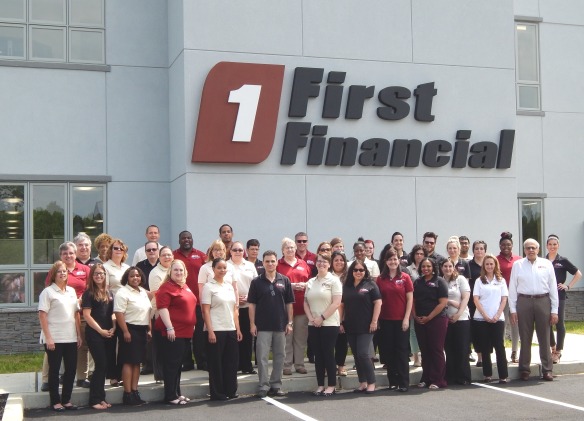
Pictured above: First Financial staff in front of their new corporate office that is now open!

First Financial Federal Credit Union’s new corporate office is now open (www.firstffcu.com) and located at 391 Route 9 North (next to the Howell Park & Ride) in Freehold, NJ 07728.

The credit union’s new corporate office is located on the same property as their newest branch which opened in early 2015, the Freehold/Howell Service Center (389 Route 9 North).  This branch now serves about one third of the credit union’s nearly 19,000 members.

This new corporate office boasts two stories, spans 20,000 square feet, and has the same modern design as First Financial’s newest branch directly in front of it.

In regard to the credit union’s new corporate location, Issa Stephan, First Financial’s President/CEO stated, “We are dedicated to Monmouth and Ocean county residents and businesses, and we were fortunate enough to be able to buy this land on a main highway like Route 9 and build our new corporate offices. The new building will provide enhanced operational efficiencies that will help us to grow and evolve to keep pace with our members’ needs.  The corporate location represents our commitment to our members and our investment in Monmouth and Ocean counties to deliver a member-centric approach to banking.  This is a win-win-win for New Jersey, for our First Financial employees, and for our members.”

###

About First Financial Federal Credit Union:

First Financial Federal Credit Union (formerly Mon-Oc Federal Credit Union) is a not-for-profit financial cooperative whose goal is to provide the highest level of quality products and personalized services while maintaining financial integrity and stability.  Our vision is to be a long-term financial partner with our Members. While First Financial has a highly trained, professional staff using the latest technology, we also pride ourselves on our personal touch. Unlike huge banking conglomerates, policy setting and overall strategic direction of First Financial are overseen by a volunteer Board of Directors made up of credit union members. The credit union is federally insured by the NCUA. For more information on First Financial, visit www.firstffcu.com.

9 Hacks for a Perfect Monthly Budget

Pencil on the statement of payroll details

While the word “budget” may want to send some of us screaming in the other direction, creating a successful budget is actually one of the biggest gifts we can give ourselves. It not only helps you out financially, but it does a ton to reduce the day-to-day anxiety so many of us feel when it comes to our finances.

If you’re losing sleep over your monthly finances but don’t know where to begin, here are eleven helpful tips for getting started with a monthly budget.

Grab Your Calculator and Block Out Some Time

Grab your calculator, a pen and paper, and open that Excel doc — and most importantly, block out some time for this. Really figuring out what you spend can take a few hours, and one of the most important parts of this process is simply scheduling some time to do it.

Record Your Take-Home Pay

The first step in any budgeting process is to figure out how much you take home each month. Don’t include anything that automatically gets subtracted, like a 401k or taxes — you just want to know what you actually have in your pocket each month.

Subtract The Essential Expenses

Subtract all of the “essential” expenses you absolutely have to pay each month, like student loans, rent, car payments, cell phone, etc. Take time to really think about every bill that comes in.

Allocate For Savings

You now have the amount of money you can use for personal choices — as in you can literally do whatever you want with it. Things like groceries, clothes, and take out all fit into this category. And in a piece for Nerd Wallet, financial writer Anika Sekar says this is now when you allocate for savings (or “paying yourself first” as some retirement planners put it). She recommended saving at least 20 percent after taxes, which comes to about 12-16 percent pre-tax. If you already accounted for a retirement fund in a previous step, you can factor it into this assessment.

Assess The Numbers

Now is the time when you assess the balance of your numbers. In a piece for the financial site Learnvest, financial writer Laura Shin recommended the 50/20/30 rule of thumb. This system says that no more than half your income should go to necessary expenses, no more than 20 percent should go to savings, and no more than 30 percent should go to everything else. If your ratio is coming off far from this, think about re-balancing.

Get Into The Nitty-Gritty

Now it’s time to break down that 30 percent, “personal choice,” portion of your budget. Figure out all the little things you spend on each month — from coffee, to manicures, to ordering in. It’s important to be realistic during this process.

Make Some Cuts

It’s entirely possible that after completing the above step you realize that you spend way more than your allocated 30 percent on random stuff. This is the stage where you might need to figure out where you can cut some expenses. Maybe it’s making coffee at home, or limiting yourself to a take out order just once a week, or maybe it’s not letting yourself “just pop in” to a store after work because you know you always end up buying something.

Consider A Money Tracking App

If all of this seems overwhelming, consider a money-tracking app on your phone. DailyWorth.com recommended Mint.com, Goodbudget, and Mvelopes as a few of their top choices for personal budget helpers, but you can definitely research around to see which one best suits your needs.

Remember — Treat Yourself Sometimes!

Budgeting doesn’t mean restriction. It just means knowing where your money is actually going. Don’t get overwhelmed at the thought of a monthly budget or think a solid budget is out of reach. Just remember it’s about informed choices so you can enjoy the money you make!

7 Benefits of a Credit Union Credit Card

Here are seven reasons why consumers should consider using a credit union credit card:

1. You’re a member-owner. When you join a credit union you are a member-owner, not a customer, and this means you have the privilege of voting for the board of directors – volunteers who help lead the credit union.

First Financial Holds Ribbon Cutting Ceremony for Freehold/Howell Service Center

Press Release

1st Financial - Howell Grand Openeing

Pictured above: First Financial’s New Freehold/Howell Service Center Ribbon Cutting Ceremony

Wall, N.J. – First Financial Federal Credit Union (www.firstffcu.com), a financial cooperative owned and operated by its members, recently held a ribbon cutting ceremony to celebrate the opening of the credit union’s newest branch at 389 Route 9 North (next to the Howell Park & Ride) in Freehold, NJ.

In attendance were several Howell Chamber of Commerce members including 2nd Vice President Tom Comer, Executive Director Susan Dominguez, John McGeehan from CentraState Health Care System, and Linda Apointe from Sam’s Club. Members of the First Financial Board of Directors and Supervisory Committee were also in attendance, as well as President/CEO Issa Stephan, realtor Marshall Kern, Freehold/Howell Branch Manager Dan Dunn, and members of the First Financial corporate office staff and Freehold/Howell branch staff.

The week of the Grand Opening was highlighted with special offers and prizes for members and the community. “Our first priority is achieving our members’ financial dreams by defining their financial goals and lifestyle, empowering them with financial education, helping them to plan their retirement, and manage their risk – and our newest branch will be a key vehicle in helping us to fulfill this promise with our membership,” said President/CEO, Issa Stephan.

1st Financial - Howell Grand Openeing

Pictured above: First Financial staff with President/CEO Issa Stephan and Board Chair Gordon Holder

This branch will now be a primary banking location for approximately a quarter of the credit union’s 20,000 members and features many important banking conveniences such as a drive thru, drive up and walk up ATMs, and more to come.

More photos from the ceremony are available by following First Financial on Facebook at www.facebook.com/firstfinancialnj.

1st Financial - Howell Grand Openeing

Pictured above: President/CEO Issa Stephan and Board Chair Gordon Holder cut the grand opening ribbon.

# # #

About First Financial Federal Credit Union:

First Financial Federal Credit Union (formerly Mon-Oc Federal Credit Union) is a not-for-profit financial cooperative whose goal is to provide the highest level of quality products and personalized services while maintaining financial integrity and stability.  Our vision is to be a long-term financial partner with our Members. While First Financial has a highly trained, professional staff using the latest technology, we also pride ourselves on our personal touch. Unlike huge banking conglomerates, policy setting and overall strategic direction of First Financial are overseen by a volunteer Board of Directors made up of credit union members. The credit union is federally insured by the NCUA. For more information on First Financial, visit www.firstffcu.com.

How To Save When You’re Young

Businesswoman saving moneyIt’s hard to save money when you’re young. If you’re lucky enough to have a job, you’re probably not overflowing with cash. With a ton of young and talented job seekers, companies also have little pressure to offer generous starting salaries.

Meanwhile, apartment rents have steadily risen for 23 straight quarters, and life’s other inevitable expenses — utilities, food, taxes, etc. And these haven’t gotten any cheaper.

Let’s not forget educational expenses too. Inflation in college tuition has massively outpaced broader consumer price inflation for decades, meaning most college graduates start their careers with large student loan debts hanging over their heads. A recent poll found that college graduates finish their studies with an average debt load of $35,200. And if you are the ambitious type who decided to go to graduate school, you might have multiple hundreds of thousands of dollars in student loan debt.

Still, the savings you manage to sock away while you’re young will have an outsized effect on the lifestyle you’re able to live when in middle age and your golden years.

Pay Yourself First.

Humans are hardwired to expand our spending to absorb any increases in income. In order to mitigate these impulses, you have to “pay yourself first” by allocating your first dollar of income to savings rather than your last. Figure out a dollar amount that you want to save, and set it aside before you budget your regular monthly expenses.

If your employer offers a 401k plan, this is easy enough to do. Your 401k contributions come out of your paycheck before you have a chance to spend them. Not including the value of employer matching, if your employer offers this – is an “out of sight, out of mind” way to save for your retirement one day.

Even contributing $500 per month to savings will get you to $6,000 per year, and many young workers can try to make do with $500 less per month.

Make it Automatic.

Very closely related to paying yourself first is making your savings as automated as possible. For example with a 401k plan, this accomplishes both. Once you set your contribution limits, your company’s payroll department will take care of the rest. It’s automated, and you don’t have to think about it.

But what if your company doesn’t offer a 401k plan? There are plenty of other ways to automate your savings process. Often times, your payroll department will allow you to split your paycheck among two or more accounts. This will allow you to automatically divert whatever sum you can afford away from your primary checking account and into a savings or investment account.

You can also generally instruct your brokerage account or savings account to automatically draw from your checking account on a specified day every month. The key here is automating the process so as to remove your discretion. If you have a real emergency, you can always suspend the automated instructions for the time being. Otherwise, you have made saving part of your monthly routine and made it a lot harder to throw the money away on something frivolous.

Slash Your Budget.

Let’s face it, it can be easier said than done when your monthly bills seem to get bigger every month. Here are a few concrete examples of how to save without crimping your lifestyle too badly.

First off, ditch cable TV. Most of the programming you watch is probably available for free over the airwaves or at a very modest cost with Hulu Plus or Netflix  after a short delay. And the handful of shows not available probably aren’t worth the $100 per month or more you’ll pay in cable bills. If you can’t live without HBO, chances are good that one of your friends or relatives has a subscription that you can borrow from time to time.

Also, try to put off a new car purchase as long as possible. If you take reasonably good care of your car, it will last you 150,000-200,000 miles. Not only will you save money on a car payment, but the older your car the less insurance coverage you will need. And when you finally do need to replace your wheels, buy a late-model used car rather than a new one.

Did you know at First Financial, our auto loan rates are the same whether you buy new or used? Be sure to check them out today, and if you like what you see – you can apply for an auto loan online 24/7.*

Consider cutting your rent and utilities bills in half by having a roommate. Chances are, you did it in college. Why not share an apartment for a few more years? The average apartment rent is more than $1,000 per month, and it is considerably more in the popular urban cities that attract younger people. Cutting that bill in half will make reaching your savings goals a lot easier.

*APR = Annual Percentage Rate. Not all applicants will qualify, subject to credit approval. Additional terms and conditions may apply. Actual rate may vary based on credit worthiness and term. First Financial FCU maintains the right to not extend credit, after you respond, if we determine you do not meet our guidelines for creditworthiness. A First Financial membership is required to obtain an Auto Loan and is available to anyone who lives, works, worships, volunteers or attends school in Monmouth or Ocean Counties.

Article Source: Charles Sizemore for investorplace.com, http://investorplace.com/2014/12/how-to-save-when-youre-young/#.VL65zNLF8uc